Showing posts with label Flatbed Load Securement. Show all posts

Improvisation

Here is a unique way of tying down a load with what has to be one of the cheapest methods I have seen.  The flat hook strap is hooked onto a standard trailer winch which is designed for a flatbed winch track.  


This is keeping the pipe wrapped tightly for the small cost of about 25 bucks and it's reusable. 


This Blog

This blog is the culmination of my years out here on the road.  Watching changes in policy, equipment, laws, and procedures, I've seen quite a bit.  I am by no means a "know-it-all". 

I'm constantly learning, and when I do see something new, I file it away and then share some of it with you folks.  One thing you can count on staying the same is the fact that everything changes.  If you don't like it, just wait a while;  it might get better or worse, but it won't stay the same.


Feel free to ask about anything in trucking that's of interest to you and I'll do my best to give you answer based on my experience and knowledge. 

As far as the new HOS, the CSA, and the EOBR/ELD fight, they're still changing.  The CSA is under review.  The latest HOS update is being screamed about by everyone.  And the EOBR/ELD has millions of drivers upset.  And the OOIDA continues to fight the legal fight for us. 


Let me give you an example of something that changed a few years ago that affected me as a flatbedder.  It had to do with the regulation specifying that bungee cords could not be used to secure freight, or securement devices.

The new regulation stated that you can't use a bungee cord to hold anything on your trailer and binders have to be secured with a wire tie, chain, zip-tie, or baling wire. 

This load (not mine, just a photo I took in a truck stop) is chained down, but the binders are secured with bungees.  This is not allowed.

The bungee cords are not strong enough to keep the binder from popping open.  The "handle" on each binder must be kept tightly closed and to do so, a stronger securement device is needed.
This binder has no securement at all.  Any amount of vibration or movement could cause this binder to pop open, causing the chain to loosen.  If this steel train transmission were to get loose and fall off the trailer, it can cause incredible damage or worse, death.
Any freight you put on your trailer needs to be secured properly.  You're responsible for knowing which securement devices are best (straps or chains) and what the rating is on that securement device based on the weight of the freight.  Everything you put on your trailer needs to stay on your trailer. Other than the bungees being used, the securement of these transmissions are good.  They're in the right place, they just need to be bound to prevent them from snapping open. 

I use a piece of chain about 6"-8" long with a snap link on it which has served me well.  Since it's metal, they can be used over and over for years, whereas wire, zip ties, and other types of binder securement has to be discarded after use.


Keep the bungees for tarping and get in the habit of using the proper binder securements for your chains and binders. At the very least, it'll keep you from getting a written violation or being put out of service (or both), and at the most you may save a life.
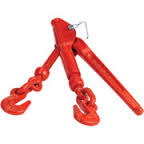
New binders have been invented that have built in safety features which help prevent the snap style binders from popping open.


And finally there is a small device which is similar to the chains I use to secure snap binders.  It is a "U" shaped piece of metal with a pin that holds it securely onto a snap binder.
 
Of course there is always the ratchet binder which needs no locking mechanism as it will not pop open.
 

Know How To Un-Do Before You Do

Just as you would need to know how to off-load the truck before you fill the trailer with freight, you need to have a plan to release the securement devices that hold everything on the trailer.

Once a chain or strap is mounted over or through the freight on the deck of the trailer, it will need to be adjusted along the route, and then removed on the other end. If you place a strap where it will get caught in or on the load so that it wont come loose when you loosen it at the unload area, you are in for a trouble.  Chains pose a similar threat as well, but also are far heavier than straps causing a situation that could result in injury.

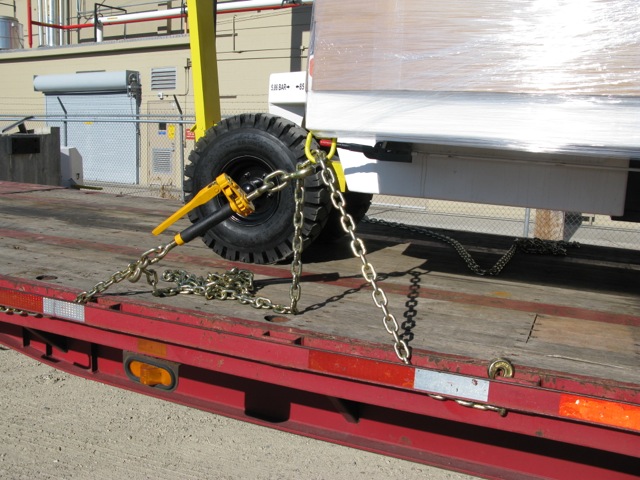
A snap binder like the one pictured here needs to be used so that when you reach your destination, you can remove it safely.  There are several things wrong with the binder in this picture.  It is tightened upside down so that it will be hard to release and it is secured with a bungee cord, which is illegal (I use a chain with a snap ring).

If this snap binder were on the other side of the chain it could be removed easily and safely.  Whoever placed this binder on this load is in for a tough time removing it later on down the road. 

The same could be said of a strapped load which is compressed by the straps during transit.  Once you have arrived at your destination and it is time to release the straps, you could be in a dangerous situation.  Every care should be taken to make sure that you are nowhere near a point of impact should the load free itself during strap removal and fall off the trailer.

 Knowing how it will be unloaded will be a key in knowing how to secure it to the trailer.

Exit Strategy

When you book freight and show up to haul it, the customer expects you to tell them how to load your trailer.  Sometimes they tell you how they want the shipment situated, but they usually wont be unloading it, so it's in your best interests to have a plan in place before proceeding. 

Many times when you take the freight off, the receiving customer wont have the same type of dock area that the shipping customer has.  You might back into a dock and have pallets loaded from the rear with a pallet jack or a forklift.  Then when you unload that same shipment, the customer might want to remove the freight on the trailer from the side.  If you have a van trailer, you might load carpet rolls with a forklift that has a carpet roll attachment installed and then arrive at the destination where they don't have the same type of equipment.

It is important to ask how it will be taken off the trailer while you're loading because it might dictate how it is positioned on the trailer.  Many times the best thing to do is to call the receiving end and ask how it will be taken off.  If it's obvious how it will be off-loaded then there are no worries.  If you were putting pallets into a van trailer then usually van trailers are unloaded with a forklift or pallet jack. 

Sometimes it seems obvious that the freight would be loaded and unloaded in the same way, but it's not.  On a flatbed, you are more likely to run into this situation because flatbeds can be backed into docks,loaded from the sides, or from the top as with a crane.  It's best to know how the shipment will be off-loaded before it's put on the trailer.  If you don't know, you should ask and if you can't find out, you shouldn't load it. 

You don't want to arrive at a receiver and be stuck in their yard while they are trying to figure out how to unload the trailer.  In one instance, I had a large piece of odd shaped alloy steel loaded in a way that the shipper considered right side up and the receiver considered upside down.  This receiving customer needed a special tool to flip the freight over just to get it off the truck.  There was no way to know that it was loaded upside down because many times the freight isn't something that you've ever seen before. 


Keeping Track

Here is a mobile platform which is capable of lifting thousands of pounds up to 40 feet high.  It broke down so they needed it moved elsewhere to be fixed.  
This tracked vehicle is controlled by a handheld wired control and is completely self contained with an engine and hydraulics.
 This is a direct tie down method which only yields 1/2 Working Load limit as the chain goes from the trailer through the tie down point back to the same side of the trailer.  Four 5/16" chains were used yielding 9400 lbs. of total tie down force.  The chains' main purpose is prevent sideways,forward, or backward movement.  Alone, they weren't enough to legally secure the vehicle so straps were used in addition to the chains, but I had put the camera away at that point so they aren't pictured here.
 The snap binders were used although ratchet binders would have been better here.  The snap binder ended up resting against the trailer rub rail.  4 inches of overhanging securement devices is allowed legally.  The snap binder was secured with a small twist link chain that has a spring clip attached to it. 
 The chains are supposed to be wrapped around the stake pockets instead of hooked directly to the trailer, but since this was a prototype trailer, the manufacturer neglected to share this information with me and after doing this load I learned the correct way to attach the chains.  Thanks to MacGyver for sharing this knowledge with me.  
It never fails that no matter how much you think you know, you never stop learning and things never stop changing.  Combine this with the technology that is being invented every day, and you have a busy time ahead of you trying to keep up.  

Coils


Coils are some of the toughest types of freight to haul because of their concentrated weight in one small area on the trailer.  They pack a punch if they get loose.  There are many stories of these coils rolling through truck cabs and through vehicles after their chains and straps loosen up.  The trailer pictured here has small blocks called "turtles" that slide from front to rear and from side to side on the trailer.  Just one of these blocks can support the entire weight of the trailer. 

In addition to the chains there are also straps going over the coil.  The chains have been known to be damaged by the coils and the coils have been damaged by the chains so there is a metal chain protector in between the chains and the coil.  The chain protector has little humps on it to keep the chain centered on the protector.  These protectors were always made of steel, but there have been some made of steel and then covered in tough rubber to give both protection to the chain and to the freight.

Pictured here are snap binders which are my preferred type of binder.  The don't rust, are easy to use, and if secured properly, will last the entire trip without having to be tightened again.  Since these chains are going from one side of the trailer back to the same side, they are only getting half of the working load limit.  The straps go from one side to the other so they are getting the full working load limit.

There are three basic ways to load a coil:  Eye to the sky (the style seen on the coils to the front of the trailer), shotgun (the style of the coil towards the rear of the trailer), and suicide (where the coil is loaded so that the eye in the center of the coil is facing the sides of the trailer).  The two ways depicted here are the preferred loading styles for coils and the safest being eye to the sky.  The coils that are loaded eye to the sky style are secured using straps with strap protectors and these coils are also heavily wrapped in plastic so it is unlikely that the straps would be cut in a sudden stop.  Chains are the best method for securing all types of coils and a coil would never be secured in either eye to the sky style or suicide style without chains.

The eye to the sky or suicide coils have coil racks, dunnage (4X4 lumber) and rubber pieces between the coil and the trailer.  This gives the coil a cradle to sit in to minimize movement of the coil.  Because the coils have so much weight in such a small area, they can damage a trailer very easily.  Many flatbed trailers have a marking on the frame rail specifying where the placement of one single coil ,that is the maximum weight the trailer can handle, will sit safely.  In the case of this trailer, the maximum load for the trailer is 60,000 lbs. and there are coils that weigh that much.  I wouldn't be able to haul a coil that heavy, but if you were set up to haul one that heavy, you would want to make sure that the coil was situated perfectly.  Not only do you need to worry about the securement of the coil to prevent it from falling off the trailer in the event of an accident, but you need to make sure that the coil doesn't damage the trailer.

These coils were tarped and protected from the elements to arrive safe and sound thousands of miles away.  The metal was used in a factory to eventually become car parts. 

Twisted Straps

Have you ever held a piece of paper up to your lips, pulled it tight and blew on it?  If you did it right, you just turned a piece of paper into a musical instrument.  If you are dealing with a $30.00 strap this same principal can ruin your investment and actually decrease the chance of the freight staying put on your deck.  Here is an illustration of how air at speed can affect the object that it is flowing around.  In this case a load strap.  On the bottom near the letter "c" the air flow is minimal causing barely any movement in the object being affected by the air.  As you climb up to "b" and "a", the vibrations increase.  These vibrations can wreak havoc on load straps


In this picture, the straps are exposed to the air:
Here is a set of crates that were to be transported without a tarp.  There is a picture of an umbrella on these crates and that means that this load should be tarped, but the customer did not want it tarped so it wasn't. The straps are clearly seen with a twist in them.  The distance the straps are from the load and from the trailer to the top of the load is a factor.  On a short load or where the load is as wide as the trailer is, a twist is not necessary.

If there were no twists in these straps, the air would cause vibrations in the straps. The straps would rub violently on the load at all of these points:

The twist keeps this vibration from happening.  All there needs to be is one twist in the strap in between the top of the load and the trailer on this load.  In addition to this the load requires strap protectors which are the small plastic pieces that cover the edge of the crates where the strap touches the load. 

If you didn't twist these straps, they would vibrate and stretch and loosen up as you drive down the road.  They also will rub on the trailer, the load, and wear the strap out.  This load required 8 straps.  They are about $30.00 each so that is about $240.00 worth of straps.  Properly maintained straps can last for ten years on hundreds of loads in all weather conditions.  Improperly maintained straps will last you one load.  Maybe even two. 

The Good, The Bad, And The Ugly

THE GOOD

I'm going to start posting some pictures on here of some flatbed loads.  I am calling it "The Good, The Bad, And The Ugly" after the movie of course.  And if you know anything about truckers, you know that we love that movie.  Who doesn't love that movie?  These aren't necessarily my loads because it would take years to compile a long list of my flatbed loads on here.  At the truckstops and along the way, I have seen numerous loads that will make for good and bad examples of how to secure a flatbed load. And each one will be labelled with one of my three monikers.  Here we go:

This is a Humvee that is chained down with the direct method of chaining using one chain on each end of the vehicle.  This is the best method of chaining this type of freight.  There are only two chains on each Humvee.  One chain on the front and one on the back of each vehicle.  This gives each tie down point half the working load limit (WLL). Though indirect would yield the entire WLL, it isn't needed here because the weight of the Humvee is low enough for 1/2 the WLL on each tie down point.


Note how the excess chain is draped through the pintle hook on the vehicle so it doesn't hang down on the trailer.  Knowing the right working load limit for the freight will allow you to get the right size and number of tie downs for each load so that you don't have to work too hard, and still achieve more than the needed securement for the freight.


Chaining each tie down point independently on vehicles with tires and suspension, keeps the vehicle from moving in any direction.  It also works with the suspension of the vehicle to keep the chain binders from popping off the chains.  When vehicles with suspensions and inflated tires are transported on trailers, they move up and down on the trailer depending on the condition of the road and the ambient outside air temperature.  Lower temperatures deflate tires and as you drive the suspension will expand and contract.  You want to tighten the binders and chains as much as you can, but you will never completely get the play out of it because of the suspension and tires.


You should keep track of the regulations in regards to each load that you haul so that you are in compliance with the FMCSA and the DOT.  For this load, I have listed one of the important regulations below:

Section 392.9 of the FMCSA regulations states that the operator must:
(2) Inspect the cargo and the devices used to secure the cargo within the first 50 miles after beginning a trip and cause any adjustments to be made to the cargo or load securement devices as necessary, including adding more securement devices, to ensure that cargo cannot shift on or within, or fall from the commercial motor vehicle; and(3) Reexamine the commercial motor vehicle's cargo and its load securement devices during the course of transportation and make any necessary adjustment to the cargo or load securement devices, including adding more securement devices, to ensure that cargo cannot shift on or within, or fall from, the commercial motor vehicle. Reexamination and any necessary adjustments must be made whenever—(i) The driver makes a change of his/her duty status; or(ii) The commercial motor vehicle has been driven for 3 hours; or(iii) The commercial motor vehicle has been driven for 150 miles, whichever occurs first.Click here to see the complete FMCSA Rule

The Strapping Good Times Of Flatbeds

The strap of choice for flatbed operations is 4 inches wide X 30 foot long. The straps come in different colors. Usually they are yellow, but blue, red, green, and orange are also common. Straps are made of polyester webbing and hold up to all environments. They can withstand heat, cold, rain, and prolonged exposure to dry weather. They can be rolled up into a tight roll when not in use and stored for years without breaking down. Most flatbed operators will carry enough straps to secure the entire loaded trailer. The usual amount of straps needed is 14, but it is wise to carry at least 18 straps just in case one breaks, is damaged, or the load requires more securement.
The straps have several different types of anchors. The anchor is how the strap attaches to the trailer or the load. The most popular type of anchor that a strap has is called a flat hook.


The second most popular is the chain anchor strap. The chain anchor is the strap of choice for me. It allows for angled movement and provides better stability where the anchor attaches to the trailer. They also have better resistance to being damaged during an accident because of how they wrap around the trailer tie down point.

Straps are the preferred method of load securement for many types of loads, from pallets to jet engines. They are used on average more than chains and more than wire rope. Their main benefits are lightness of weight, ease of use, and amount of working load limit they are rated for. Their main drawbacks are that they are easily damaged by sharp objects, they stretch, they will expand and contract depending on the environment they are used in, they are flammable, and lastly they do break easier than chains. All in all, I prefer chains to straps, but straps get the job done more times than chains are able to.

Direct Tie Down Versus Indirect Tie Downs

There are two accepted methods for securing a load.  Direct and Indirect.


Shown here is Direct Securement:


Here is an example of Indirect securement with only half WLL:
True Indirect securement for full WLL would show the chain going from one side of the trailer to the other side.


Direct securement is a method where the securement device goes from the trailer to the load.

Indirect is a method where the securement device goes from the trailer, through or over the load and then back to the trailer.

Direct securement reduces the Working Load Limit (WLL) of the securement device by half as it doesn't spread the force of the tie down to the entire tie down.  This method will put the entire load securement of the tie down point the device is tied to onto one tie down point on the trailer. 

Indirect securement allows the entire WLL of the securement device to be used on the tie down point it is tied to, over, or through as long as it goes from one side of the trailer to the other.

Over time there will be pictures on here of different tie down methods as well as explanations as to why those methods were chosen and how they hold up during transit.

Oversized Load 3 Delivered

Although I do check every load everytime during transit for shifting and loose articles, this load never moved and the securement devices never loosened.  The tarps arrived just as they were when I loaded them.  More than 2000 miles away.  Proper securement is essential.


Oversized Load 2

Now the tarps are secured to the trailer.  The front flap is rolled up into itself and the grommets are connected together with the "S" hook of the bungee.
This same technique is used for all front and back extra flap material.


The final result is a tarped and secured load.

The load is completed with 2 oversized load signs and 8 red flags.

Oversized Load 1

An oversized load that was only 9 feet, 4 inches wide.

I started with 4 pieces of wooden dunnage that were 4 X 4 X 8 feet wooden timbers.

Next the freight was placed on top of the dunnage.  I used 2 pieces of dunnage per piece so that the dunnage wouldn't come loose and so that the freight is stable.  Each piece was secured with 2-  5/16 inch chains and 2 - snap binders.  The chains were pushed through the holes in the freight with 10 foot long 1 inch aluminum square tubes.  After the snap binders were secured, they were wrapped with a small twist chain with a snap link attached, then the excess chain was wrapped around the binders.

The next step after placing and securing the freight is to protect the freight from the elements and also to protect the tarps from the freight at the same time.  To start off, I used edge protectors on all sharp edges and then layed felt pads out over the load.


Now the felt pads are unrolled over the entire load to protect the tarps from the sharp edges of the sides of the load.
Now the tarps are unrolled over the entire load, starting with the back tarp and then the front tarp is unrolled over the front tarp.