THE GOOD
I'm going to start posting some pictures on here of some flatbed loads. I am calling it "The Good, The Bad, And The Ugly" after the movie of course. And if you know anything about truckers, you know that we love that movie. Who doesn't love that movie? These aren't necessarily my loads because it would take years to compile a long list of my flatbed loads on here. At the truckstops and along the way, I have seen numerous loads that will make for good and bad examples of how to secure a flatbed load. And each one will be labelled with one of my three monikers. Here we go:
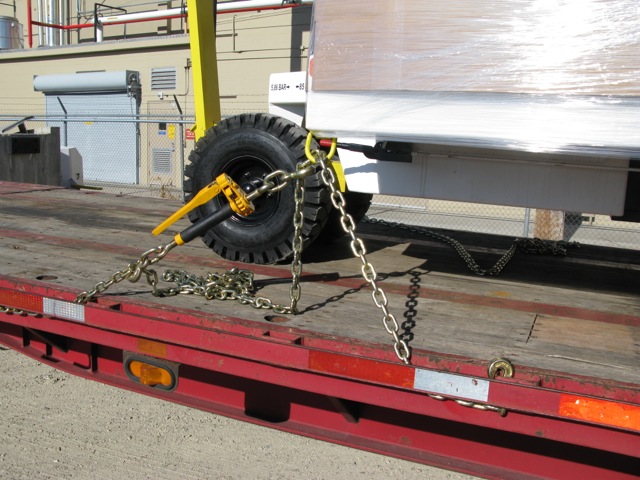
This is a Humvee that is chained down with the direct method of chaining using one chain on each end of the vehicle. This is the best method of chaining this type of freight. There are only two chains on each Humvee. One chain on the front and one on the back of each vehicle. This gives each tie down point half the working load limit (WLL). Though indirect would yield the entire WLL, it isn't needed here because the weight of the Humvee is low enough for 1/2 the WLL on each tie down point.

Note how the excess chain is draped through the pintle hook on the vehicle so it doesn't hang down on the trailer. Knowing the right working load limit for the freight will allow you to get the right size and number of tie downs for each load so that you don't have to work too hard, and still achieve more than the needed securement for the freight.

Chaining each tie down point independently on vehicles with tires and suspension, keeps the vehicle from moving in any direction. It also works with the suspension of the vehicle to keep the chain binders from popping off the chains. When vehicles with suspensions and inflated tires are transported on trailers, they move up and down on the trailer depending on the condition of the road and the ambient outside air temperature. Lower temperatures deflate tires and as you drive the suspension will expand and contract. You want to tighten the binders and chains as much as you can, but you will never completely get the play out of it because of the suspension and tires.

You should keep track of the regulations in regards to each load that you haul so that you are in compliance with the FMCSA and the DOT. For this load, I have listed one of the important regulations below:
Section 392.9 of the FMCSA regulations states that the operator must:
(2) Inspect the cargo and the devices used to secure the cargo within the first 50 miles after beginning a trip and cause any adjustments to be made to the cargo or load securement devices as necessary, including adding more securement devices, to ensure that cargo cannot shift on or within, or fall from the commercial motor vehicle; and(3) Reexamine the commercial motor vehicle's cargo and its load securement devices during the course of transportation and make any necessary adjustment to the cargo or load securement devices, including adding more securement devices, to ensure that cargo cannot shift on or within, or fall from, the commercial motor vehicle. Reexamination and any necessary adjustments must be made whenever—(i) The driver makes a change of his/her duty status; or(ii) The commercial motor vehicle has been driven for 3 hours; or(iii) The commercial motor vehicle has been driven for 150 miles, whichever occurs first.Click here to see the complete FMCSA Rule